Thursday, January 27, 2011

Paper Reading #3: Experience in Social Affective Applications: Methodologies and Case Study

Comments
Comment #1: Adam Friedli
Comment #2: Paola Garza

Reference Information
Title: Experience in Social Affective Applications: Methodologies and Case Study
Authors: Paul Andre, Alan Dix, M.C. Schraefel, Ryan W. White
Conference: CHI 2010 Atlanta, GA

Summary
Taking into consideration the various social networks and connections and the experience of use as well as the affect and focuses on two key aspects. The concept and design of a tool to share well-being information and evaluating the experience of how that information is precieved, interpreted and used. The goal of this paper is to find an appropriate evaluation solution in an application which detects the affect of the user. Motivated by psychology the Healthii application tool is used for conveying the well-being status in a social network. It consist of four dimensions: busy; enjoyment; stress and health, with three possible values: not; quite and very.

The emotions could be set using an interface and it could also be customized with other adjectives. The author states that this application isn't novel, but what is novel about this application is that concept being studied (flexibility, not within constraints) and the specific methodology used. The study took place among a group of friends and over the series of five weeks. The group would meet each week; and a survey was taken at the end of the five weeks to get individual feedback. In order to find an acceptable way to measure they combined the concepts from various other methodologies in similar affective studies. This centered in on the awareness of the user, the awareness of others in the group and tailoring both the concept and tool to fit the user's desired experience, promotion of discussion, and sufficient period of evaluation of the experience to promote higher level of discussion. As results didn't necessarily meet the desired goals of the project's team, they end the article stating that this paper was aimed to inform a discussion on whether or what types of methodologies are needed, what attributes to use in order to study and learn from them in that field of study.

Discussion
I was looking forward to reading a paper on a case study. I personally think implementing applications with the intent of conveying affect is very neat. As I started to read their experiment I realized that indeed, this wasn't a novel application. I've seen similar applications on various other places that do similar things, about at least 3 years back. When I was reading the results they disclosed that this didn't really produce the desired outcome as they expected. I found it interesting how they had argument after each finding to, in my opinion, justify that they found something useful. I can identify with the users in some sense because I think that I wouldn't want to be updating my emotion status, with the other usual status that we often update in facebook or twitter. I remember I used a similar application on facebook a while back and yeah, I often neglected to update the emotion status. Even people that update it rather frequently it's rare that you'd update it with ever emotion change in your day. So while I think the application is somewhat interesting (I must admit the first thing I noticed was that they were using a Mac from the pictures and coincidentally they used i's in their application name, I'm such a dork, haha). Nonetheless, I wasn't too impressed with there findings.

Tuesday, January 25, 2011

Paper Reading #2: Interaction Design in the University: Designing Disciplinary Interactions

Comments
Comment #1: Paola Garza
Comment #2: Patrick Frith

Reference Information
Title: Interaction Design in the University: Designing Disciplinary Interactions
Authors: Gale More, Danielle Lottridge
Conference: CHI 2010 - Atlanta, GA, USA

Summary
Interaction design is a field that is rooted in both HCI and design communities which came about in the late 1990s. This paper asks whether "interdisciplinarity" agenda could be used in the university, since most departments boundaries are seen as being 'virtually synonymous in how a department is regulated and evaluated. Three types of knowledge production are identified as Interdisciplinarity, multidisciplinary and transdisciplinarity. Interdisciplinarity describes activity where two or more disciplines are engaged to create one product, where it is a synthesis of ideas and methods. Multidisciplinarity is defined as research that involves more than a single discipline in which each discipline make a separate contribution. The third type of crossing is transdisciplinarity, which is the primary focus is not on the disciplines but that they are working together in a context of a specific problem or application. It is this one that is most challenging to academic norms in which knowledge is produced in the university, due to how a university functions traditionally departmental, as a way of accountability, yet this method is said to have the most potential for innovation. This could be seen in examples of papers written across departments and in a panel at INTERACT which focused on a scenario of developing of an in-vehicle emotion sensing system to deal with the problem of car accidents caused by aggressive driving or 'road rage'.

Discussion
The concept of working together across departments is something that isn't new to me or my work in HRI. I think that's it's very common that we often come together to contribute and solve a problem, in a sense that one are of discipline alone is going to solve a particular issue. While this might be seen as against traditional work, I think we've already begun to function as a transdiciplinarity of knowledge production in various areas of research with a goal to overcome the obstacles within a various fields.

Monday, January 24, 2011

HCI Remixed - Microblogs

Chapter 1: My Vision Isn't My Vision: Making a Career Out of Getting Back to Where I Started
William Buxton
Microsoft Research, Toronto, Canada

J. K. Pulfer, 1971: "Man-Machine Interaction in Creative Applications"

Summary
William Buxton discusses how he went from being an individual who was studying music in his university to someone who integrated his studies in music with computer technology. Where it began as a bribe for him to go to the NRC and tryout there computer music system, what he got to experience there was something that later became his career. He begins to explain the detailed description of this music machine and how a person would interact with it in order to create and produce music and how he sees this system as one that is developed better in HCI than any system ever did for 20 years after that time.

Discussion
I grew to appreciate the author's honesty in how he wasn't extremely fond of the idea of working with a computer system. Yet you could see how his interest were pulled towards this field as he explained the music computer system with such detail and enthusiasm. His enthusiasm also reflected how well the design of this system was done well (however, I'm sure it might not have been so highly praised by all users, as it is impossible to please everyone). It's important to remember that people will be able to be successful at using products and probably have better results when they are given a product that is intuitive in understanding and to use.

Chapter 4: Drawing on SketchPad: Reflections on Computer Science and HCI
Joseph A. Konstan
University of Minnesota, Minneapolis, Minnesota, U.S.A.

I. Sutherland, 1963: "Sketchpad: A Man-Machine Graphical Communication System"

Summary
A drawing program called SketchPad and the studies which helped formulate this program is explained in this paper. This software is similar to the early generations of computer-aided design (CAD) software. The author explains the HCI and computer science behind this program by explaining four examples. The first of the examples is pointing with a light pen, which allows the user to point, select and alter objects in the drawing with the use of a certain pen. The second example that is given is to discuss the rendering of lines, circles and text which with rendering algorithms it could help perfect the drawing, even at different angles. The third example discussed was the constraints and their display. These constraints were often at work behind the scenes of the drawing construct the various shapes in the drawing. The last point discussed was the data structures, algorithms and programming structures; which took the object-oriented approach and various algorithms to make this program robust, useful and reliable in computing. He closes the chapter by explaining three lessons learned from this program, demonstrating how HCI along with computer science go hand-in-hand to create such programs.

Discussion
This SketchPad software seems to be a very interesting, useful system. The one thing that I did wonder about it was how "user-friendly" this system really was. While it probably had a lot of great functions, it might have been confusing to some users. It would have been of interest to see screenshots of SketchPad to get a better visual of the program.

The Mouse, the Demo and the Big Idea
Wendy Ju
Stanford University, Stanford, California, U.S.A.

D. Englebart, 1968: "The oNLine System (NLS) Demo"

Summary
This paper begins by discussing the video which demonstrated the Engelbart mouse demo. It was something that to the author originally seemed to fit into their environment, as she explains growing up around computers and her parents worked for IBM. However, in viewing this demo it provided a more in dept look at how the mouse was created and functioned. The author explains how although it was fascinating to her to see the demo, Engelbart had a difficult time getting an audience for his idea even after the NLS demonstration. She ended the paper talking about her perception of Big Ideas taken from the reaction of the mouse demo.

Discussion
People often take for granted the simple things in life and a lot of times it takes a lot to impress and get the approval of someone else when we come up with a idea or product. Just thinking of how products are on the market and yet, often people find some function to complain about them or that they feel the product doesn't add up to par. A big part of evaluating a product in my opinion is how valuable it can be to one's environment and life. Just thinking about the mouse, a simple device perhaps, but it is valuable to how we navigate our computers, and many hand-held devices. Just think how many of us are Really that awesome with keyboard shortcuts, most of us use our mouse or mouse pad to do most things on our computer.

Chapter 18: Observing Collaboration: Group-Centered Design
Saul Greenberg
University of Calgary, Calgary, Canada

J. Tang, 1989: "Listening, Drawing, and Gesturing in Design: A Study of the Use of Shared Workspaces by Design Teams"

Summary
This paper takes the discipline of computer-support cooperative work (CSCW) and discusses studies of shared work surfaces. A study started by Sara Bly, and later extended by a man named John, observed how people worked together when drawing on a table surface compared to a white board surface on a wall. The following observations were made. The orientation of the drawings, when in front of the person better helped facilitate the meeting compared to using a mounted paper on a wall. Second, the proximity of the paper was better placed on the table compared to the wall in order to be more of a key role in mediating the conversation. Third, simultaneous access also found to be helpful, which is a basic framework, along with gesturing facilitated the conversation. As these discoveries were being made it lead to the development of software which allowed drawings to be shared and conversations guided by pictures and diagrams drawn.

Discussion
This article had more of a visual aid than did the previous papers. It reminded me of a lot of the popular product which is now used to record a conversation connected to what the person draws or writes with the Livescribe pen. Being a visual learner I've grown to appreciate products that take both the audio and visual aspect when documenting a conversation or sharing information with a group at a meeting or lecture. I've come to realize that sometimes just the visual or audio standing alone isn't always as effective (just think of just hearing your lecture or trying to remember what exactly was being said when looking at your notes... sometimes that's hard to piece together from memory).

Chapter 20: Taking Articulation Work Seriously
Geraldine Fitzpatrick
University of Sussex, Brighton, U.K.

K. Schmidt, and L. Bannon, 1992: "Taking CSCW Seriously: Supporting Articulation Work"

Summary
The author of this paper begins by discussing about the discipline of CSCW and how it centered on their college career. Coming from the ground up on this topic the author shares how it focuses on "cooperative work" which combines the "mutual dependencies" and "articulation work" and the importance of taking into consideration the mechanisms of interaction and coordination of mechanisms of that shared social space as described from the work of Schmidt and Bannon.

Discussion
This paper points out the importance of remembering the factor of CSCW and how that connects to all areas of computing and even throughout technology. It's an important factor to remember and can greatly impact the overall design or implementation of a project.

Chapter 23: Video, Toys, and Beyond Being There
Brian K. Smith
The Pennsylvania State University, Park, Pennsylvania, U.S.A.

J. Hollan and S. Stornetta, 1992: "Beyond Being There"

Summary
The author compares computer-mediated-communication (CMC) to face-to-face (F2F) communication and how it can relate to the analogy of crutches or shoes. He emphasizes that often CMC is not 'beyond being there' but rather it can relate to a crutch for communication, and often not chosen when given the option to communicate face-to-face. Through personal experiences he discusses the "emotional design" and "experiment design" are factors of study in HCI and how technology integrates and impacts our lives.

Discussion
I was surprised at the emotional touch of this paper, I suppose I wasn't expecting it from the title. Nonetheless, it did teach and remind me of a few things. I was reminded how valuable communication is and how we're fortunate to be able to communicate via CMC when we can't talk in person. I see now that even our childhood toys (which have an intelligence to them, or maybe not) can remain as a impact on our lives. I thought about my own childhood, but perhaps more of my 2 and a half year-old Godson Ernesto (aka Neto, pronounced in Spanish, not English). I think of all the computer-related toys he has and how it's helped him grow and develop; and yes, I'm guilty of singing along with his musical toys. I often associate the memories of my Godson to the toys he is very fond of, and I suppose I'll carry those memories forever. Nonetheless, without CMC I wouldn't be able to communicate with my friends on the other side of the world and often my family.
Me and Neto: Thanksgiving 2010

Chapter 24: A Simulated Listening Typewriter: John Gould Plays the Wizard of Oz
Chris Schmandt
MIT Media Lab, Cambridge, Massachusetts, U.S.A.

J. Gould, J. Conti, and T. Hovanyecz, 1983: "Composing Letters with a Simulated Listening Typewriter"

Summary
The author opens this paper by explaining how he was part of some of the first speech recognition projects and transitions to the work of John Gould. While his experiment is known to have a "Wizard of Oz" definition because it wasn't really a speech recognition system, it did give some valid information in user studies and specifications of such a system and how it would be accepted by others.

Discussion
I knew by the title that this would be an twisted outcome. Personally I would be disappointed if I found out I was deceived by a system and it wasn't legitimate. Nonetheless this experiment did show some interesting factors to take into consideration when developing a system which does speech recognition.

Chapter 25: Seeing the Hole in Space
Steve Harrison
Virginia Tech, Blacksburg, Virginia, U.S.A.

K. Galloway and S. Rabinowitz, 1980: Hole in Space (video)

Summary
The author explains his time at Xerox PARC in 1985 and the Media Space Project (electronically created shared work spaces), which led to encountering the Hole in Space project. Through a friends referral the author meets two artist. Kit Galloway and Sherrie Rabinowitz, which worked in the "astetetic research in telecommunications." Through video-mediated connection the Hole in Space was created, which was between the sidewalks in the Lincoln Center in New York and through the Century City in Los Angeles. It didn't consist of user instructions, local feedback monitor explanatory didactics, but just a projected black-and-white image of the other location. People behaved in ways that they didn't normally with strangers they encountered on sidewalks and they were engaged with each other. It was through video mediation that these people created an event and even 'community.' This led to further experiments in electronic cafes but weren't as successful due to the growth of the Internet.

Discussion
I found the ending of this paper rather interesting. In talking about the Hole in Space I began to recall how we connect to different parts of the world through CMCs and different networks. I can understand why this was probably an intriguing concept back when this project first came into play; however, with the advancement with technology and the Internet it's something that we might take for granted.

Chapter 26: Edward Tufte's 1+1 = 3
Scott Jenson
Google, Mountain View, California, U.S.A.

E.R. Tufte, 1990: Envisioning Information

Summary
The paper opens up with a quote from Edward R. Tufte about the principle of 1+1=3 in information design. The author takes the scenario of the buttons in an elevator and his horrified experience of accidentally closed the elevator doors instead of opening them, because he pressed the wrong button. In an effort to correct the two "sins" he mentioned with the principle of 1+1=3 were reducing the clutter by for example, using pictures to symbolize the meaning versus shapes that could be misinterpreted. The second "sin" he mentions is to remove the choice altogether. Since the choice to close the doors, in his opinion used to hurry the process of the elevator because someone was in a hurry, it wasn't absolutely essential. In working to correcting the 1+1=3 it minimizes that problem and makes a process more effective on a technical aspect.

Discussion
This was something that I was just pondering on today as I was exiting the garage where I park my car. I have noticed how those buttons can sometimes be misused, or in my case I might press a button out of habit, even when the doors are already closing (I don't really know why I do that, probably a delayed reaction which is common for me, but I digress). I have noticed the effectiveness of pictures in my travels around the world. I picked up on that in airports (probably because I was in Germany or Estonia where I couldn't read descriptions). I also liked the idea of color coding objects to guide certain behaviors.

Chapter 27: Typographic Space: A Fusion of Design and Technology
Jodi Forlizzi
Carnegie Mellon University, Pittsburgh, Pennsylvania, U.S.A.

D. Small, S. Ishizaki, and M. Cooper, 1994: "Typographic Space"

Summary
This paper describes the typographic space system which allowed three dimensional graphics to allow the designer/programmer to apply basic typographic attributes, which included the attribute of motion. This led to the focus of kinetic typography and the RSVP technique which was used to convey an intention of emotion in that message. It could indicate the pitch, loudness and tempo changing by the size of the text. Through mimicking human actions it could convey emotion and used in portraying characters and dialogue.
Discussion
I've seen this concept implemented in a video of a speech where the phrases in a speech where written out and the text was animated with various sizes and colors, so I could see how this is an effective method of communicating a message. The author closes this paper talking about it's been implemented in movies and I can see how this would also be effective. I think it also emphasizes the meaning of the statement because you can associate the various kinetic factors to understand the message.

Chapter 28: Making Sense of Sense Making
Steve Whittaker
University of Sheffield, Sheffield, U.K.

A. Kidd, 1994: "The Marks Are on the Knowledge Worker"

Summary
Analyzing how store and organize our data two claims are made: Memory prosthesis, computers are mainly used for passive storage of information but it may not be useful according to the author of the original paper. Second, sense making is not well done with computers with the current way of techniques of organization, such as the use of folders. Theirs is a distinction between making sense of something and managing tasks. The author states that AI won't help because it's not effective in task management. Now that we're in the digital era where it's vital to remember we process new information as well as valued the stored information.

Discussion
A valid topic to ponder and remember, however I found it strange how the paper just kept reinforcing the concepts by introducing new questions. Maybe I enjoy papers that introduce a concept and then show experiments and results to work towards making that topic more effective at solving a desired problem. I can understand the concerns because I can vividly remember the times I'm trying to go through old saved information to find some specific file and how all I really have is my distant memory of where I put it and the fact that I try to organize them in a chronological order.

Chapter 34: Revisiting an Ethnocritical Approach to HCI: Verbal Privilege and Translation
Micheal J. Muller
IBM Research, Cambridge, Massachusetts, U.S.A.

A. Krupat, 1992: Ethnocriticism: Ethnography, History, Literature

Summary
What began as an initial interest in finding ways to think about the Native American cultural works the author also got new insights in ethics, politics, and epistemology. This provided people involved in HCI a new perspective on some of the current problems but useful solutions. Taken from the history involving the Native Americans the HCI ethnohistorian can often analyze work based on their own. They are often trying to fit their results to the rules of evidence and argumentation that are used by the 'higher power'. So in order to do things correctly it's important to mediate between both groups. The author explains the three major principles of multiculturalism, polyvocal polity and heterogeneity and closes with the ethnocritical heuristics of the analyst's location, translation as a core process in HCI and verbal prvilige as a core problem in HCI.

Discussion
Before this class I don't think I was as aware of how valuable concepts from anthropology are to the field of technology, specifically in research. It's very important to take into consideration how we analyze things in order to get the fair results and if you want your findings to have truthful impact.

Chapter 6: A Creative Programming Environment
Henry Lieberman
MIT Media Lab, Cambridge, Massachusetts, U.S.A.

D.C. Smith, 1977 "Pygmalion: A Creative Programming Environment"

Summary
This researcher began in doing research at MIT Artificial Intelligence Lab string to make programming teachable to young children in a way that they could explore, hypothesize, experiment and understand what math and science was all about. When given a copy of a thesis from Standford (1975) it related back to his original interest. It introduced Pygmalion: A Creative Programming Environment and the author and advisor were well known work in Henry's particular line of interest, but was a thesis in both computer science and philosophy. The author then recollects his encounter with Smith and his first experience with Pygmalion and how it crashed. Although there were no backups, there were many innovations of Pygmalion, which had a focus in the notations and meanings behind graphical programming languages. One of the most important ideas that the author had was to "program by example" and it lead to supporting creativity through visual programming by example. Some of the lessons the author took from Pygmalion for today's HCI are: don't let big questions scare you; think globally, act locally; hunt for good stuff, even in the out-of-the-way places; teach by example. In closing something like this probably wouldn't be accepted in HCI today, but it should hold the possibility of profoundly transforming the field with discoveries like this particular one.

Discussion
I thought this was an interesting paper. I appreciated hearing about the author's experience with the original thesis writer. I could connect to this concept because I've always been someone who is focused on working with youth and making programming something that can be graphically represented, understandable and fun.

Chapter 7: Fundamentals in HCI: Learning the Value of Consistency and User Models
Sara Bly
Sara Bly Consulting, Oregon, U.S.A.

The Xerox Red Book: Star Functionality Specification, Revision 5.3 for Start-1, 1981

Summary
The author opens up this paper talking about the system called Xerox Star and the documentation called Xerox Red Book. The book is organized around two categories document creation and document management. There were three aspects that was impacting to the user: user interface specification, consistency, and desktop metaphor. The user interface combined a number of innovations from personal computing, GUI, mouse input device, the office metaphor, email, windows and LAN. This interface design is still in use today. There was consistency in how the functions where implemented in the system. The Desktop metaphor is based on it's office-like function features.

Discussion
I found this as an interesting way to describe the functionality of a computer system. It had some obvious factors that I never really deemed as important, but now that I've read this paper I see how valuable and under appreciated they are at times.

Chapter 9: The Disappearing Computer
Norbert A. Streitz
Fraunhofer IPSI, Darmstadt, Germany

M. Weiser, 1991: "The Computer for the 21st Century"

Summary
The concept of the disappearing computer was for the 21 century. The author of this paper ponders on how we are now in the 21st century, the time intended for this concept. The goal of this concept was to minimize the interaction problem. Live Board was a computer that was designed to test this concept. Building on the Live Board system allowed the DOLPHIN system to be put in place. The author notes the shift between human-computer interaction to human-information interaction and human-human-interaction and cooperation, which implies the computer should disappear from the scene. The author points out two types of disappearance: physical and mental. Physical being size and mental being that they are no longer seen as computers but everyday objects. They then transition to LiveBoard to Romeware where it spans an entire wall. They also emphasize the importance of smart, people-oriented systems.

Discussion
The first thing that came to mind when seeing the title was how we are seeing a disappearing factor in today's society. Just looking at how computers have gotten smaller in size and a lot of technology has gotten smaller. I do believe we have several devices that we don't see as computers anymore, but rather vital objects that are a part of our life.

Chapter 10: It Really Is All About Location
Anind K. Dey
Carnegie Mellon University, Pittsburgh, Pennsylvania, U.S.A.

R. Want, A. Hopper, V. Flacao, and J. Gibbons, 1992: "the Active Badge Location System"
Summary
The phrase "location, location, location" is not only applicable to businesses but to technology as well. The Active Badge is introduced in the paper and they discuss it's capabilities to be able to track a person based on just wearing the badge, based on picking up sensor input. They tried this on a study done with 32 employees for two weeks. Although they found that the system could be compromised, for example they could stop tracking by just not wearing the badge. Nonetheless, based on this invention it led people to study more intently and 16 years after the Active Badge the use of GPS and network services became very popular.

Discussion
I found it interesting to learn about a system similar to our present day GPS navigation systems. Over the years this has been a novel design that is now very useful for many, many things.

Chapter 46: The Essential Role of Mental Models in HCI: Card, Moran, and Newell
Kate Ehrlich
IBM Research, Cambridge, Massachusetts, U.S.A.

S.K. Card, T. Moran, and A. Newell, 1983: The Psychology of Human-Computer Interaction
Summary
This paper describes the psychology behind computer-human interaction, specifically the mental models used in CHI. The mental models outlined earlier were GOMS, which stood for Goals, Operators, Methods, Selectional Rules. Goals represented the set of things that the user wanted to do using the computer. Operators are the actions that belong to the user's skills. Methods were the sequence and subgoals accomplish the overall goal. Selectional rules correspond to the multiple methods that could be done to do some task. The model would have to specify what method is to be used to accomplish the task.
Discussion
This reminds me of something I would have found in "The Design of Everyday Things." I think a lot of times we don't realize how valuable it is to specify the Selectional rules because it can cause confusion since there is often multiple ways of performing a task.
Chapter 47: A Most Fitting Law
Gary M. Olson
University of Michigan, Ann Arbor, Michigan, U.S.A.

P.M. Fitts, 1954: "The Information Capacity of the Human Motor System in Controlling the Amplitude of Movement"
Summary
Based on information from psychology Fitts's law is introduced MT = a + b log2 (2A/W) where MT is movement time, a and b are constants, A is distance of movement and W is the width of the target. A number of ideas came from the understanding of Fitts's law. The value of the edge on the screen. One of the things that Mac and Windows do differently. The value of pop-up menus, selecting from a pop up window, Fittsizing a menu, organization of walking menus, expanding items as you move toward them. While there are a number of movements which Fitts's Law is too simple, but it does factor into a successful design.

Discussion
The user interface of a Mac and Windows computer is different indeed. I do appreciate the menu layout on Mac's versus Windows can get confusing because they aren't always directly on the edge. I think maintaining the Fitts's Law is applicable when it comes to designing a successful interface to avoid confusion.

Sunday, January 23, 2011

Ethnography Ideas

1) To observe the benefit and impact of working a technical related job (both in college or post-college--in there career) when not studying a technical related field in college career. (for example, Instructional Media Services hires student workers for three separate media centers Harrington, Blocker and West to setup and maintain the usage of the technology in classrooms for there prospective areas. They often are required assist professors (users in general) or train other student workers in their knowledge of the technology and automated systems. While they are all trained to do such tasks, many of the students are majoring in non-technical fields.)


2) Observing how professors interact, understand and use the AMX automated systems which are in 120 of the classrooms within Instructional Media Services area of service. These systems allow the classroom to have various technical devices (computer with SMART Board monitors, a projector, document camera, DVD/VCR (a Blu-ray player in some cases), microphone and surround sound speakers). Once logged into these automated systems, you're provided with a user-interface AMX panel which allows you to turn each device on or off, as well as manipulate its control functions; lower or rise the projector screen, adjusting the volume of the sound system or microphone of the classroom; and switch between the use of the components by the click of a button. It not only makes the use of the equipment easier for the users but has allowed the IMS technicians to be able to troubleshooting and assist the user in enabling, using the devices and track the current state of the equipment remotely, not needing to be in the classroom, or even on campus.

AMX System in PETR 104 (Source)


3) The use of technology to assist handicap and disabled people. While so many people use technology for social or communication purposes it can be used among handicap and disabled people to assist and enrich their lives.

Thursday, January 20, 2011

The Coming of Age In Samoa - Microblog

Introduction
Summary
The growth of both science and psychology has impacted the way children and adolescence develop and how they pass through the stages of their life. Adolescence is described as a period which children were passing through a time of conflict and distress. Anthropologist have begun to study people in how they respond to the culture they grow up in and the conditions which they are surrounded by. A lot of the stages they go through in life are a factor of how they perceive the world around them. It's something that can be studied and observed from all over the globe. This book focuses on the study of a young girls upbringing in Samoa. It's a south sea island, thirteen degrees from the equator. Her ways of culture were different from the American culture and her path in her adolescence years is also different. The goal of this research being to answer the question of whether an adolescence upbringing is results in similar findings or do the different conditions influence it greatly. Striving to impact and contrast the way one educates their children.

Discussion
I've always found it interesting that we don't realize how much of our environment and culture impacts our upbringing. While I've always been a strong believer that adolescence is a critical time in a person's life, thus explains why I personally have been involved in youth ministry for many years now. I appreciated how the author made an effort to learn about the culture and even the language before entering the country to do this study. I think it's important to try and put yourself in the shoes of others as you try and learn and interact with them in their culture.

Chapter 2: A Day in Samoa
Summary
This chapter gives you a description of what a day would be like for the Samoan people. Their day starts at dawn and various individuals have different tasks that last through the night. It presents different scenarios that they might encounter and how they would act or respond.

Discussion
This chapter gave good insight to their daily lives and I find that to be very important to provide at the beginning of a study. It helps lay the foundation for those studying the lifestyle and culture of a certain group of people.

Appendix II
Summary
This appendix lays out the methodology and methods used for this study. It discussed the amount and variety of the information which she studied and explained the things that were included in (and not included) in her reported findings.

Discussion
I appreciated her honesty in how she collected her information and even the difficulties or findings that weren't obtained with their given reasons. To be completely honest I haven't read an ethnography before, but I did value her describing her methodology and methods used in a study.

Appendix V
Summary
This appendix describes in more detail the various factors which were evaluated on each girl as well as what age group and how those groups were categorized. The quantitative data was listed in forms of tables for the reader as well.

Discussion
I thought this depicted well that the author not only worked hard to perform her research of the Samoan people but that she gained their confidence to get such confidential information. These appendices remind me of a modern day research journal that you would categorize and organize your thoughts and findings.

Chapter 3: The Education of a Samoan Child
Summary
This chapter begins with discussing about a child's day of birth and the events that are a part of infancy. It progresses to discussing the early years of a child and then as the child gets older it continues in the duties, responsibilities and things which they learn growing up. Towards the end of the chapter it talks about the chief of the Samoan people and the role that he is for the community.

Discussion
I thought it was interesting to know that they do not keep track of birthdays. It was interesting to see the story of a child's education taken from the first day of their life and through their early adult years. It portrayed a picture that gave both genders way of their upbringing and allows you to see those years in parallel.

Chapter 4: The Samoan Household
Summary
The samoan village is made up of 30 to 40 households, with various different titles among the village. The household can consist of people who are blood related, married, adopted or have no close relationship to one another. The members can also be scattered among 3 to 4 houses. In the household age determines authority rather than relationship and that associate is often displayed outside in the community as well. There are some places where age doesn't determine authority, but overall the household is like a family unit open to other as well. There is also a distinction between genders as the they get older. Marriage often binds families together and one is obligated to help the other out when in need. Cooking is done by both genders and the elderly often advise the younger ones. Rank in the village and in the household mirror each other but doesn't really affect the younger children. The chapter goes on to discuss the Malae household and the roles of other people in the village.

Discussion
I found it interesting to know more about how the household function and how age had an impact on the role they played. It was also interesting to see how ranks varied for age or different groups of people. I also enjoyed the fact that what was considered the household wasn't constrained to just one particular place. It really brought everyone together.

Chapter 5: The Girl and Her Age Group
Summary
This chapter talks about how youth are a part of their society. Girls are often divided and associate with girls there own age. They are also responsible for different task depending on their age which signifies their maturity level. The same can be applied to the boys; however, they are known to associate with boys of different ages in comparison with the girls.

Discussion
This was an interesting chapter to see how much responsibility is put on them as youth. I find it interesting how interactions are grouped and done by gender, where they don't associate with the opposing gender.

Chapter 6: The Girl In the Community
Summary
The youth before age 15 or 16 are ignored until then and they have no social standing and no recognized group activity. The organization is structured and follows the order based on the title someone holds. Depending on the title you hold it defines your responsibilities and duties you are in charge of part-taking in. The roles and groups are specifically for men and women and it also defines the boundaries they have within the society.

Discussion
It was interesting to see the structure of the culture. It was also neat to see what kind of boundaries and duties these roles were defined by. We don't typically think of such constraints in an environment like ours, but this was important to note in order to understand their culture.

Chapter 7: Formal Sex Relations
Summary
The chapter begins discussing of how a girls perspective changes from childhood as she gets older in life. It discusses some of the common and uncommon practices between the relationships between the genders. It discusses the relationships that exist in and out of the marriage.

Discussion
It was interesting to note the comparison to the Christian view and how it compares to the culture of the Samoans. Much like our culture the relations between genders can vary and consist of various practices. They not only noted what was viewed as common and uncommon but also what they saw as humorous or frowned upon.

Chapter 8: The Role of Dance
Summary
Dance is an activity that is done by both genders and all ages. It is often done in groups and depending on age it varies in skill. It is widely encouraged throughout the culture and is even found among characters such as the jester. There is no formal teacher for dance but is often an analysis of one's education.

Discussion
This chapter pointed out the importance of dance in the culture of the Samoans. It was interesting to see how it varies from very young ages to older generations, how it could be very informally organized and also be within a framework of actions. I found it interesting how they discussed the difference between someone's cannot dance because of the someone's personality to be more shy and reserved, versus, someone who may have had physical problems but danced anyway. It seems that the emphasized the importance of being bold and wanting to be expressive and less on how you were expressive as we often do in our culture today.

Chapter 9: The Attitude Towards Personality
This chapter expands on the details of the Samoan culture in regards to people's personalities. The author describes the term "musu" attitude and how it's common among the culture. Also she presents the term "Ta iloy" which is what they answer when they don't want to answer a question. It is also common for the negative opinions of someone to be expressed versus what is common in other cultures. It is also common for them not to have privacy in a lot of aspects of life.

Discussion
I thought it was interesting how the Samoans perceived attitude. Although I could relate to how they present their attitude. For some reason it reminded me somewhat of the Hispanic culture and I was able to pick out the similarities.

Chapter 10: The Experience and Individuality of the Average Girl
This chapter explains how it is for a girl to grow up in the Samoan culture in that they grew up tending to children at a young age and knew more about biology, life and death compared to knowing about society organization. The chapter expands on some of the things girls may see and a sense that the cuture is not big on public display of affection, but they are open about intimate relations. The chapter closes out on discussing some of the things which girls were known to be skilled in and what they were allowed to know as part of the culture.

Discussion
I thought this chapter really presented what growing up from a females perspective was for the Samoan culture. I do agree to some extent it is important to be open about real life issues. I know for me I was raised knowing that death was concept that wasn't hid from me at a young age. I think it allowed me to get a better perspective on how I should appreciate each and every day, not taking much for granted.

Chapter 11: The Girl In Conflict
The author goes fruther into explaining the two scenarios which a girl could be considered 'in conflict' or those that would be considered deviants. One category would be considered the good deviants of society, but in a sense they go against the normal cultural standard. Or they can fall into the negative deviant categories in that they did things that were frowned upon and delinquent in nature.

Discussion
It was interesting to see the two extremes in deviants in the culture. While I still feel that those standards somewhat hold for an American culture, I found it interesting that they do not always strive to be over-achievers in what they do, seeing that out of the ordinary. Compared to our culture here where we praise being the best and better than someone else. I was raised always hearing that as a Hispanic we weren't very supportive to seeing others succeed and we have a negative response to others doing well in life, I've only seen that in some aspects of my upbringing but have never chosen to accept that into my own way of thinking.
Chapter 12: Maturity and Old Age
This chapter begins in talking about how the Samoan culture defines the roles of married and unmarried adults. Woman and Men are not considered to be the same person once they are married, rather they are still separte belonging to there individual families. One of the most defining moments in a woman's life is the birth of her first child. Pregnancy brings about a lot of taboos that woman must take precaution towards. Where the woman have a lot of responsibilies and certain skills they are required to attain that is not an exception for woman as they get older. Even in there old age they are required to do things and maintain their skills. That requirement in role isn't the case for males in society.

Discussion
I found this aspect interesting as well in a sense that we value getting older, being considered wiser and living a life of leisure in our retirement. Or where man have usually had the dominate place in our society and woman aren't always seen as capable for doing different roles in our society. I found the adult aspects to be rather interesting, perhaps a bit odd, in a sense that certain taboos exists when woman are pregnant.

Chapter 13: Our Educational Problems in the Light of Samoan Contrasts
This chapter presents a comparison between the Samoan culture and the western American culture. In summarizing the previous points made in the former chapters the author provides suggestions in order to better our society and culture in what we can learn from the Samoan culture. For example she suggest being more open about life's issues and having a household that consists of more individuals or not putting an emphasis on affections.

Discussion
I was excited to see her applying her findings to our culture as Americans. I do agree with her in some sense that we should be a bit more open in our society in important issues. I am somewhat skeptical to think that our society would be so accepting to such views or changes but it definitely is useful to consider for our personal way of thinking.

Chapter 14: Education for Choice
This chapter covers the diffiencies of our education system in America and the author provides from the insight of the Samoan culture ways that our society could be improved. In educating children how to make choices an less on the stress of what choice to make it would alleviate a lot of the stress that children (she focused primarily on girl's perspective) would have in making life choices.

Discussion
I can agree to the suggestion that we should be more concerned with allowing our children to have choices, but of course I think that choices should be constraint to some boundaries for the safety and best of the child. I think a parent should definitely be open to talking to their children and not just instructing them that it has to be done this way 'because I said so' mentality. That in my opinion only creates a more rebellious response from the child. However, if the truth of why things are done a certain way and teaching the child the reasoning can greatly impact the direction children choose to go. In a sense that they don't feel pressured but they feel that living a certain way is based on a foundation of principles and beliefs.

Appendix III: Samoan Civilization as it is Today
This appendix provided information about how the Samoan culture was in the time of her research. It dicusses the impact that European-based countries and beliefs have impacted the Samoan culture. She does provide information which presents the way it was before that impact and how it differs compared to her time of research in regards to social structure, economy, government and way of life.

Discussion
I found this Appendix to be valuable information. I think it's important to consider the way an society and space is before the impact of different factors (such as change in who resides in the space or how things are done and advancement in knowledge or technology). As an ethnographer it's important to consider how such factors change the way things are done and how that could impact your results of your study.

The Design of Everyday Things - Microblog

Chapter 1: The Psychopathology of Everyday Things
Summary
The author explains how sometimes the design of products (from simple things to doors, telephones, and vehicles) can sometimes be misleading and inaccurate in placement (affordance). Even things that you would think are intuitive to some of the smartest people can be frustrating to try and understand. He discussed about the principles of understandability and usability and how it that consists of a good conceptual model, making things visible, proper mapping, and feedback. For example a car can be a very good product that is pretty intuitive once after being familiarized with the functions. The reason this is the case is because it has the controls visible and they are in the proper place that they correlate with their specific function. However, some telephones and multifunction alarm clocks are not as successful, because they are sometimes mislabeled and have a lot of functions, possibly in the wrong locations. With the proper placement and effort in a design product causes the complexity and difficulty levels to decrease.

Discussion
I couldn't help but laugh at how much I could identify with the introduction of this novel. I found myself thinking, "Ah, I'm not the only one that feels this way some...most... of the time. haha It's very true that the design of things can make them very frustrating and complicated devices to use. If only the designers were more conscientious of the users and that they may not view the use of the device the same way they do, I think it would save many headaches and probably help the success of some products.

Chapter 2: The Psychology of Everyday Actions
Summary
In comparison with the last chapter this chapter focuses on our actions and how we respond to them. The author points out that we are often blame ourselves for the error before considering the designer's design. He goes on to explain how naive physics can sometimes influence the way we answer different scenarios. The author explains that people are described as explanatory creatures and thus our actions often are the stem the explanation of how something works. Thus in turn, explains how people can often blame the wrong cause because we assume that if one action happens it leads to a certain result and that the two are related. This often leads to what the author calls learned helplessness or taught helplessness in explaining different circumstances or situations. The author goes on to explain the seven stages of action: forming the goal, forming the intention, specifying an action, executing the action, perceiving the state of the world, interpreting the state of the world and evaluating the outcome. The chapter closes by discussing the seven stages of action as design aids which emphases visibility, a good conceptual model, good mapping and feedback.

Discussion
In reading this chapter it reminded me something that often drives how I evaluate a product or design an interface. The seven stages of action are something that I found very useful in evaluating the usability of a product. I was also reminded of how important user testing is when designing a product; because often what seems intuitive to one person may not be intuitive to another person.

Chapter 3: Knowledge in the Head and in the World
Summary
This chapter focuses on precise behavior emerge from knowledge for four reasons: Information is in the world, great precision, natural constraints are present, cultural constraints are present. The first point they expand on is that if information is in the world we are less likely to learn it, for example with details of a coin. This also links to the point that great precision is not required, but if it is very similar to another object then it could lead to problems, such as the British pound and five-pence piece. The power of constraints can narrow what you have to think about, figuring out a word vs. narrowing it to words that rhyme and context. Although this is a known concept,yet it is something that we've been able to do differently when it comes to remembering a series of important numbers (such as identification, telephone numbers) because it meets a set of standards that human minds do well remembering. A lot of remembering different things links back to reminder cues we're given (for example placement, written reminders of events). As with all products there are various trade-offs that people will often compromise based on: retrievability, learning, efficiency of use, ease of first use and aesthetics.

Discussion
This explains a lot of why people may buy products and yet when others use it they are so confused or struggle to use it. It also reminded me of the small factors that go into why we have certain systems the way we do today, such as our currency. I realized this on my most recent trip to Estonia, because they just changed to the Euro from the Kroon.

Chapter 4: Knowing What to Do
Summary
Being unfamiliar with objects, such as the VCR can make them difficult to understand.Some of the reasons that designs may be confusing is that there are too many possibilities so it makes it difficult to understand what the path to follow to perform an action. An important set of signals is from affordances which convey the possible actions and constraints. Restraints can be be either physical (for example parts that fit in one place), semantic constraints (context of the situation) and cultural constraints (certain objects are universal in meaning, such as certain colors), or logical constraints (natural mapping and completeness of an object). The author goes on to explain that sometimes doors can be confusing because of the designs that go outside the constraints that should be followed. Switches can also be just as confusing to users because it may be hard to see what functions what object; or how the switches are arranged for the operation of a particular set of objects. The chapter closes with the importance of visibility and feedback and how sound can also be used for visibility.

Discussion
I've always found some devices rather confusing. I hadn't really given much thought to how to better the success of using such controls. I enjoyed learning about what to consider in order for controls to be more understandable to users. I especially like the layout for the light switches. I've seen how confusing that can be in a lot of the classroom's light switches (some of them are still confusing after they're fully or partially labeled... especially in the dark!).

Chapter 5: To Err is Human
Summary
Errors come in the forms of slips and mistakes. Slips result from automatic behavior, when subconscious actions that are intended to satisfy our goals get out of route. Slips show up in skilled behaviors and result from lack of attention. There are six types of slips: capture errors (ex. cards), description errors (common possibilities), data-driven errors (errors due to arrival of sensor data), associative activation errors (internal thoughts and associations), loss-of-activation errors (forgetting what needs to be done), mode errors (actions mean different things in different modes). Detecting slips can be difficult because sometimes feedback doesn't go with the person's focus of the process and the process of an action consist of levels (which correction could also be done on the wrong level). Two kinds of design lessons can be drawn from slips: prevention of slips and detection when one occurs. Mistakes result from choice of inappropriate goals are relied upon remembered experiences. Some models of thought are based on experiences that are closely related or they are like a file cabinet that has lots of cross references to other areas of thoughts. This theory is based on three beliefs: logic and order to individual structures, human memory is associative and much of our power comes from deductive thoughts. The connectionist approach is also discussed which is related to a neural nets approach. The way that it's applied in the thought process is that experiences link together, one on top of the other which averages out. The simplicity lies in the structure of the tasks, which are either narrow or shallow structures. The concept of conscious and subconscious behavior, where subconscious are regular and structured. Whereas conscious thought is slow and labored. Mistakes often occur because it is a misinterpretation of a situation, sometimes from things such as social pressure. Some things to remember in designing to avoid error are: understand the cause of errors and design to minimize them; two, make it possible to reverse actions; three, make errors easy to discover and to correct; lastly, think of actions as an approximation of what is the desired goal. In order to deal with errors force functions can be used as a form of physical constraint at one stage to prevent the next one from occurring. The chapter closes with the philosophy of design stating: put the required knowledge in the world, use the power of natural and artificial constraints and narrow the gulfs of execution and evaluation.

Discussion
I found this chapter to have some insight to errors that I didn't necessarily categorize or understand ways of preventing them. I think it's very important to take these principles into the thought of design. As we saw various examples some of them have drastic results and could be very damaging. As computer scientist we are responsible for the designs we create and we should be following a standard that is going to produce the most successful product for the users who use it.

Chapter 6: The Design Challenge
Summary
The chapter opens up discussing the unique layout of a typewriter. It has it's layout designed that way originally in order to minimize jamming of the keys. It also presents the different types of keyboards that have been distributed and experimented with. It then transitions to why designs go astray. The first reason it mentions is to put aesthetics first. The second reason mentioned is designers are typically not users; therefore, it may not be viewed from the same perspective as new individuals see it. Finally the designed product may not be use by the clients that ask for them. Designing can be complex, yet designing can be tailored to a special group. The chapter transitions to the problem with focus and how selective attention leads to tunnel vision. The example the author used is faucet designs. Returning to designer problems the author mentions creeping featurism and worshipping of false images. Some of the things that the mention that result in doing them wrong are: making things invisible, be arbitrary, be inconsistent, making operations unintelligible, be impolite, making operations dangerous.

Discussion
I thought this was an interesting chapter and it took a unique perspective on areas that I hadn't seen before. I think the points at the end of the chapter are important to remember when designing something.

On Computers

Comments
Comment # 1: Evin Schuchardt
Comment # 2: Steven Hennessy

Reference Information
The Complete Works of Aristotle - On Plants
Aristotle
Princeton University Press

Summary
This segment from this book was a writing from Aristotle on plants. He explains how plants are believed to have souls based on the various points from the plant's life span (for example, its genetics, way of reproducing, consuming food and how it sleeps). He goes on to explain how plants do not have souls like people do, rather they have partial souls.

Discussion
Aristotle had some interesting theories about a lot of things. I can see how this reading related to the reading we read on The Chinese Room. Often people tend to regard material things of such high value (as though many of the things we idolize in life has so much significance and meaning, practically a soul). I couldn't help but want to laugh when reading this (sorry) because I kept remembering the "Little Shop of Horrors" story.


Chinese Room Blog

Comments
Comment #1: Zachary Henkel
Comment #2: Stephen Marrow

Reference Information
Minds, brains, and programs. Behavioral and Brain Sciences
Searle, John. R.

Summary
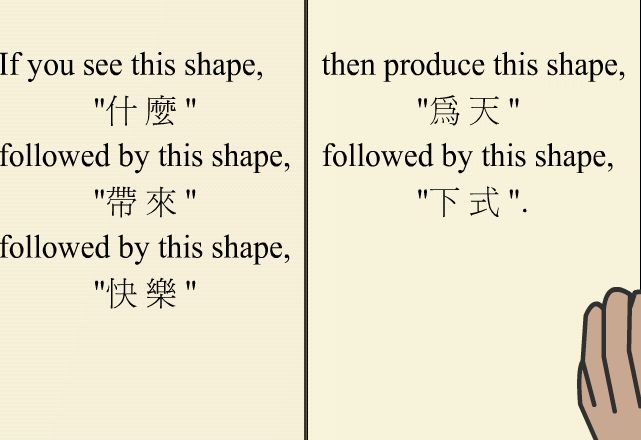
This paper discusses the analogy of a room with Chinese symbols, when given the proper information in English to correspond to the symbols, would this make the person interpreting the data be considered a person who understands Chinese with the concept of strong AI. The author then goes through a series of arguments and states whether they support or refute his argument. He closes the article by stating that strong AI does not support the hypothesis of a computer being able to understand and with intentionality or 'think'.


Discussion
This paper's argument had some valid points, yet I found it difficult to buy the "computer's can think" reasoning that he claimed some people really believe. I think that computers are capable of doing computational processing, but as far as reasoning and being correct they are not really capable of without and ever growing database of information. For some reason it reminded me of the claims from Steven Spielberg's "AI" movie. They made some similar claims basing off of neural networks and the ability to result to human thinking. I guess, I've just been exposed to a lot of the cases where the computer will attempt to compute something (especially in text, speech translation) and often get the wrong context, or not even come close to the original meaning.

Paper Reading #1 There's Methodology in the Madness: Towards Critical HCI Ethnography

Comments
Comment #1: Ethan Ballinger
Comment #2: Brian Meyer

Reference Information:
Title: There's Methodology in the Madness: Towards Critical HCI Ethnography
Authors: Amanda Williams; Lilly Irani
Conference: CHI 2010 - Atlanta, GA, USA

Summary

This paper discuss the qualitative research in HCI ethonography and how it has shifted from defined methods to methodology. It references anthropology and it's use of ethnography and how yet it's not the traditional view of "observing" rather engaging with the users on a set of methodology principles that have transitioned over time from traditional, former practices. The results show that communities merged according to similar functioning groups found globally (as found from observing DIY community practices). Due to this critical turn taken it is criteria for ethnographic rigor to impact HCI design research.

Ethnography as it impacts design (Source)


Discussion
Their is a great difference in the way that anthropology studies groups and the way that ethnography in HCI applies it. This topic was interesting and it is true that over time technology has spurred us to a similar way of functioning. While I think that in some areas methodology could be similar for design implementation products that are more universal, I am unsure at how constant that claim would be true in all other cases.

Wednesday, January 19, 2011

Blog 0: Introduction Blog

Howdy,

My name is Jessica Gonzales. This is my blog for CSCE 436, Spring 2011. This is where I plan to post my thoughts and findings on CHI topics.

First off, here's a picture of me:

E-mail Address:
unknownletter (at) tamu (dot) edu

Class Standing:
Senior (6th year)

Why are you taking this class?
I've always found Human Computer Interaction an interesting topic. For as long as I can remember, computer's have always fascinated me. I think it's interesting how people interact with computers and technology in general. It's important to keep in mind the HCI aspect in technical applications in order to be effective and successful. Its become a goal of mine, by the end of the semester, to have explored and gain skills that will guide how I approach technical applications in my future endeavors.
I also think that Dr. Hammond's research and course is very interesting. I got the opportunity to learn about her research from other students that worked in her lab this past summer, so I think taking her course would be of great value.

What experience do you bring to this class?
A lot of my experience stems from my previous and current line of work. In High School I volunteered with a technical team which was in charge of helping teachers/staff with technical difficulties or technical training. In my early years of college I worked with Instructional Media Services as a technician and office manager. At IMS I did similar duties to my volunteer role in High School, only with more advanced equipment and various custom designed software applications servicing a wide area of the TAMU campus. My office manger role consisted of training the student workers in setting up or troubleshooting various levels of automated media equipment. Now, I am currently employed doing research in Human Robot Interaction for Dr. Murphy's lab, where I work on the software aspect of the Survivor Buddy project (along side Zackary Henkel).

What do you expect to be doing in 10 years?
I think its very interesting how this very question has changed so much for me. I originally dreamed of going into Visualization Science and working with animations and special effects. That's not so much the case now that 5-something years have pasted.
Perhaps by 2021 I will have graduated from Graduate School (either in computer science or in seminary, or both...interesting combination, I know, but once you get to know me you'll see how I'd like to pull those two together).
All that I'm really sure of right now is that I long to impact, help and serve people. That might be using my computer science skills or focused in another area, and I may be in the United States or perhaps somewhere else in the world.

What do you think will be the next biggest technological advancement in computer science?
I think we'll continue to see an advancement in using technology to help and enrich lives. Perhaps it's my unique circumstance, but I've always appreciated those that strive to apply technology so that it's more effective in benefiting people in different situations or circumstances. For example, the advancements within the medical field and search and rescue.

If you could travel back in time, who would you like to meet and why?
That's tough question to answer, as I would love to meet many people from history; however, if I had to pick one, I would say Jesus. He's the one man that lived a life that impacted and changed history. When you really look at and study the person, life and death of Jesus Christ (especially the objective reality of it all), it will forever change your world; but it would have been so awesome to have personally met Him living here on Earth.

What's your favorite style of mustache and why?
Umm... a well kept one. I think the why is self explanatory.

If you could be fluent in any foreign language that you're not already fluent in, which one would it be and why?
Estonian. It's a rare spoken language and I think it sounds really neat. For the past three years, when I wasn't enrolled in classes, during breaks, I've been a missionary in Estonia, so I've grown very fond of the people there.

Give some interesting fact about yourself
I was born with a mild case of Cerebral Palsy and its shaped my entire life, but its made me who I am today. Because I grew up coping with my disability it drove me to want to be intelligent in computers (technology in general), and has factored in my desire to want to serve, help and truly love others.