Comments
Comment #1: Zachary Henkel
Comment #2: Stephen Marrow
Reference Information
Minds, brains, and programs. Behavioral and Brain Sciences
Searle, John. R.
Summary
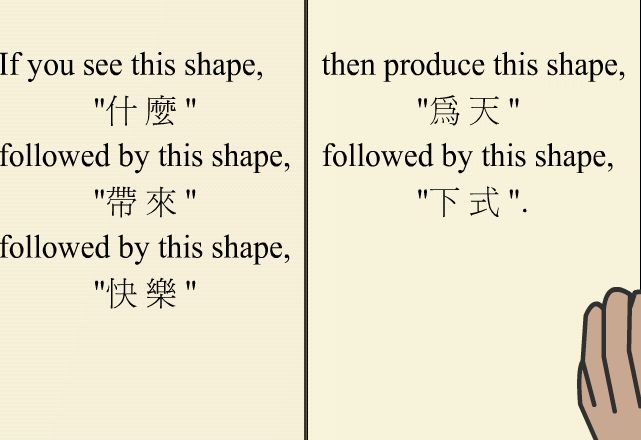
This paper discusses the analogy of a room with Chinese symbols, when given the proper information in English to correspond to the symbols, would this make the person interpreting the data be considered a person who understands Chinese with the concept of strong AI. The author then goes through a series of arguments and states whether they support or refute his argument. He closes the article by stating that strong AI does not support the hypothesis of a computer being able to understand and with intentionality or 'think'.
Discussion
This paper's argument had some valid points, yet I found it difficult to buy the "computer's can think" reasoning that he claimed some people really believe. I think that computers are capable of doing computational processing, but as far as reasoning and being correct they are not really capable of without and ever growing database of information. For some reason it reminded me of the claims from Steven Spielberg's "AI" movie. They made some similar claims basing off of neural networks and the ability to result to human thinking. I guess, I've just been exposed to a lot of the cases where the computer will attempt to compute something (especially in text, speech translation) and often get the wrong context, or not even come close to the original meaning.

Aren't our minds an ever expanding database as well? One which we fill with our experiences and our education. I do think we'll never achieve truly cognitive computers, but not because of where they draw their information. I think it's much more complex than that, such as possessing "common sense" or the desire to live.
ReplyDelete